You remember the famous ‘Boyz n the Hood’ line by Tre’s father,
“This is a neighborhood full of guys who are either hustling or getting hustled. You either play the game, or the game plays you.”
The dialogue often implicitly or explicitly stereotypes certain neighborhoods as being crime-ridden—but it also critiques the social conditions that create that reality.
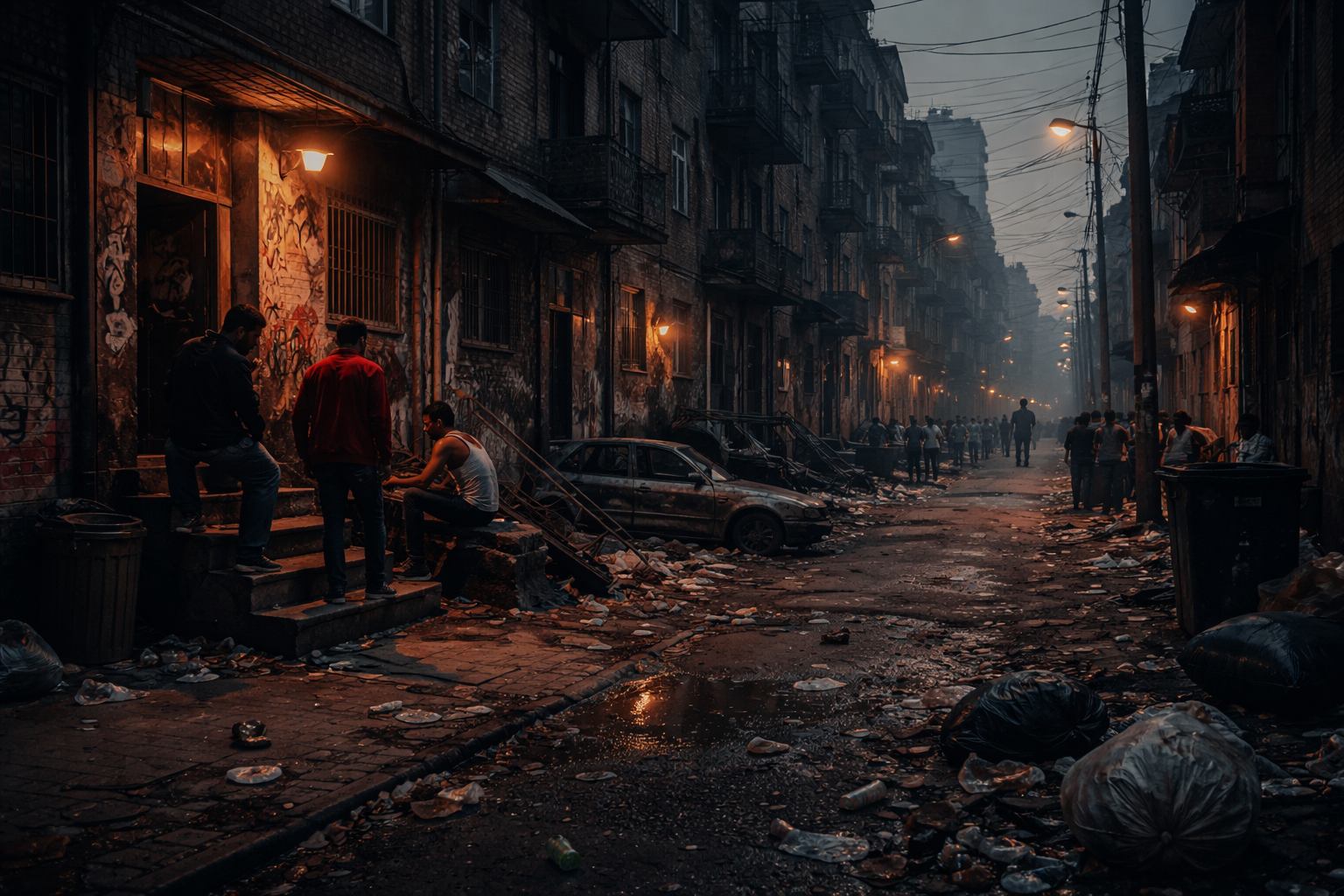
Every city has its infamous neighborhoods, the ones your mom warned you about. The ones people lower their voices for. At first glance, they look ordinary. Same roads. Same buildings. But when you look closer, the cracks begin to appear.
Abandoned spaces, broken windows, dingy corridors, no streetlights, isolated apartments, public drinking, vandalism, etc. Not just decay but signals to prospective offenders that no one is watching. No one cares. No one will intervene.
Disorder is a predictor of crime. Visible long before the crime itself. Minor offenses and ordinary violations are evidence of a neighborhood slowly slipping. Crime, after all, is not always individual. It is environmental. It is often shaped by the spaces we move through and the ones we are forced to remain in.
Inordinate population density, mixed land use, and restricted resources often symbolize a culture of dependence, with low stakes and low attachment. When everyone is transient and no one feels responsible. And when no one feels responsible, wrongdoers blend in.
One way criminologists measure this disorder, or more precisely, the “fear of crime,” is through “SYSTEMATIC SOCIAL OBSERVATION.” It is done by just watching what is already visible in public spaces.
And these observations indicate that garbage on the streets, abandoned cars, litter, graffiti, and needles and syringes are signs of physical disorder. Social disorder looks different and might include public intoxication, presumed drug sales, loitering, and the presence of groups of young people as signs of gang membership.
As early as the 1960s, U.S.-born Canadian urbanologist Jane Jacobs highlighted the relationship between the physical environment and crime. Her concern was prevention, not punishment. She believed well-designed public spaces could discourage crime by encouraging presence. Her optimistic vision of a well-designed public space called for action by citizens because the police cannot be everywhere at the same time.
And this idea later crystallized into what we now call “Neighborhood Watch.” It was formally introduced in the USA, most notably by the city of Seattle’s Police Department in 1974. It entails groups of neighbors becoming organized and keeping an eye on each other’s property. Anything suspicious is noted and passed on to the police.
Where mutual trust exists between neighbors, they are more likely to report crimes and intervene for the common good as compared to the neighborhoods where people are isolated and do not trust each other. This mutual trust and intervention is termed “COLLECTIVE EFFICACY.” The willingness of a community to regulate itself.
In conclusion, disorder might not always be proof of potential crime, but it has a correlation with crime, especially non-predatory crimes like robbery and theft. It is the structural characteristics of neighborhoods, as well as neighborhood cohesion and informal social control—not levels of disorder—that most affect crime.
Where collective efficacy was strong, rates of violence were low regardless of observed disorder. Therefore, disorder matters, but cohesion matters more. The real drivers of crime are not broken windows alone, but broken bonds too.
Leave a Reply